London Anthropology Day
Content

18
Oct
The British Museum | London
London Anthropology Day
Event registration: London Anthropology Day registration
UG
Join us at London Anthropology Day (LAD) on Friday 18 October at the British Museum!
Come and speak to us about our Social Anthropology programmes in Edinburgh. We’ll be available at our stand throughout the day, and Dr Siobhan Magee will be hosting a workshop.
LAD Workshop
Politics and Relationships in the US: An Anthropological Perspective
In this talk, Dr Siobhan Magee will discuss her research on marriage and other relationships in Virginia, USA. Personal relationships are very often at the centre of how people think about and discuss their lives, but they are also of great interest to governments, faith groups, activists, and the general public. The talk shows how marriage laws in Virginia have changed in line with changing attitudes towards ‘race’ and sexuality. It also discusses how changes to marriage law might themselves have the power to change social attitudes. How do anthropologists learn about history and memory in the place where they are doing research? How might they explore both big news stories and very personal memories?
At the School of Social and Political Science, we believe that the study of anthropology is one of the best ways to grow. An MA in Anthropology will grow:
- Your knowledge of the world
- Your understanding of societies, their differences and what factors are involved in shaping those differences
Awareness of current challenges to societies and potential consequences
Our anthropology undergraduate programmes
We offer four undergraduate social anthropology degrees at the School of Social and Political Science and it's also possible to combine with other subjects.
- Social Anthropology (MA)
- Social Anthropology and Politics (MA)
- Social Anthropology and Social Policy (MA)
- Social Anthropology with Development (MA)
Find out more about the wide range of opportunities available.
World-leading teaching & research
You'll meet many SPS academic colleagues on your journey here. Here's just a few!
- Professor Laura Jeffrey
Professor of Anthropology of Migration; Dean of Research

Laura has a longstanding ethnographic interest in Indian Ocean islands, particularly Chagos, Mauritius, and Seychelles. She also led a work package on labour migration and connective infrastructure in Maldives as part of an ERC Consolidator Grant on roads and the politics of thought: ethnographic approaches to infrastructure development in South Asia.
Laura's long-term ethnographic engagement with the displaced Chagossian community culminated in the inscription of Chagossian sega tambour music on the UNESCO List of Intangible Cultural Heritage in Need of Urgent Safeguarding. The nomination file drew on an AHRC project CHAGOS: cultural heritage across generations.
Visit chagos.online to browse virtual exhibits, download recipes, and listen to the Chagos Tambour Group album. This work built upon:
- An ESRC project on debates about sustainable resettlement and environmental conservation in the context of the Chagos Marine Protected Area (MPA) and the UK government's policy review on resettlement of the Chagos Archipelago
- A Leverhulme project on Chagossian onward migration to the UK
- An ESRC project on the politics of victimhood amongst forcibly displaced Chagos islanders in Mauritius.
- Dr Lotte Hoek
 Senior Lecturer and Head of Subject, Social Anthropology
Lotte is a media anthropologist whose ethnographic research explores the social, political and technological lives of the moving image in South Asia. Lotte is interested in the encounter between empirical audiences and the aesthetic and technological aspects of film as well as the place of the moving image in political mobilisation and contestation. Her research asks about the technological contours and political efficacy of transgressive media images in South Asia and combines ethnographic methods with archival work to explore this question.
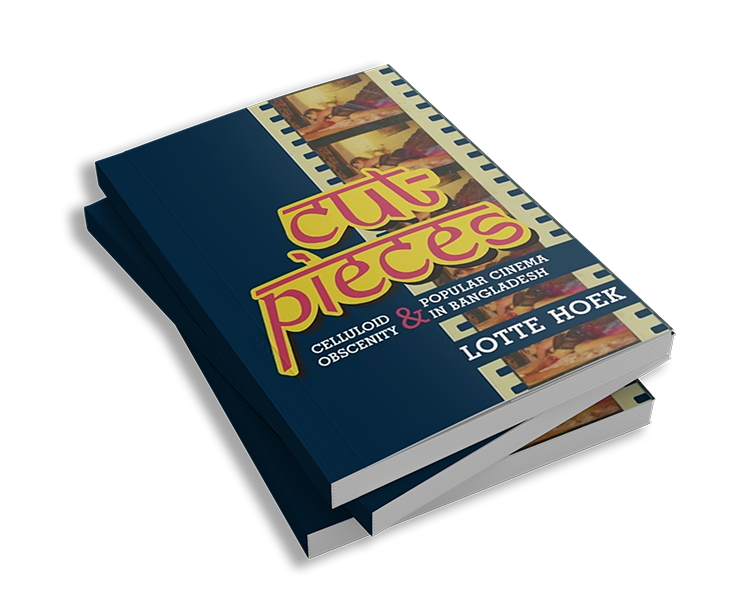 Her monograph Cut-Pieces: Celluloid Obscenity and Popular Cinema in Bangladesh (Columbia University Press, 2014) is an ethnographic exploration of the practice of making and screening illegal sexually explicit celluloid. The book was awarded the 2016 Bernard S. Cohn Book Prize.
Her new research engages the places of the moving image within state practices in eastern Bengal since 1947.
Further info
- Some short videos from Lotte's research:
- Podcast featuring some of Lotte's work - Contemporary Dissent – Echoes of the ’80s
- Research blog: 'De Media Automatiek'.
- Dr Jiazhi Fengjiang
 Lecturer, Social Anthropology
Jiazhi is working on an ongoing book project that explores the political, moral, and economic lives of ordinary people who strategised volunteering and charitable work in coping with political-economic restructurings in contemporary China. She has conducted long-term ethnographic fieldwork in southeast China and rural central China on work, ethics, mobilities and social change. Currently, she is also working on a graphic anthropology project that explores the potential of drawing as an alternative means for anthropological knowledge production. And she is developing a new research project on Chinese transnational humanitarianism in Southeast Asia. Before joining the University of Edinburgh, she worked at the Max Planck Institute for the Study of Religious and Ethnic Diversity as a postdoctoral researcher, and at Princeton University as a Global Fung Fellow.
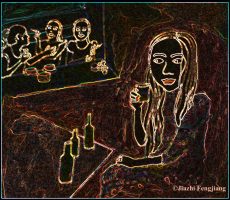
'To be a little more realistic'* Her latest publications include: Remaking the value of work: The emergence of grassroots philanthropy in China, which is forthcoming in American Ethnologist; and The desire to help: Vernacular humanitarian imaginaries in China, forthcoming as a part of the special issue Vernacular Humanitarianism in Social Anthropology.
Her article 'To Be a Little More Realistic': The Ethical Labour of Suspension among Nightclub Hostesses in Southeast China is the winner of the 20th William L. Holland Prize for the best article published in 2021 Pacific Affairs.
*'To be a little more realistic': graphic image from long-term ethnographic research with a group of young women migrants working as hostesses in high-end nightclubs in southeast China
- Dr John Harries
 Senior Lecturer and Director of Undergraduate Teaching in Social Anthropology
John’s interests span time and temporality, indigeneity and identity (particularly in postcolonial settler societies), matter and materiality, the senses and the environment, Canada, Newfoundland, the Beothuk, social memory, contentious heritage, human-animal relationships and cats.
Remembering the Beothuk
Over the last few years John has been conducting research concerning the ways in which the people of Newfoundland, Canada, remember the Beothuk, a native people of that island who became extinct (or were exterminated) in the early 19th century. Through this research John has been addressing the question of how we may theorise the presence of the past. This is particularly a concern with the material traces of past lives, be they human bones or scratches on stones, and how these traces are enfolded into the work of individual and collective memory, particularly in the context of settler colonialism.See: The Bones Collective for more information.
Human-animal relations and CATS (it may never happen)
Emerging from a long-standing affection for, and entanglement with, feline friends, John is imagining a project that explores the relationship between small cats and humans in the urban environment. The focus would be on emerging interspecies cosmopolitanisms, ontological otherness and the mircopolitics of cat-human sociability in diverse ethnographic settings. John admits that at the moment this is an idea more than a reality, but maybe someday soon?- Dr Magnus Course
 Senior Lecturer in Social Anthropology
Magnus’ research interests include: ethnography; memory, language and identity; Gaelic Scotland; fishing and the sea; Chile; South America; death, religion and ritual; Italy; purgatory; kinship, personhood and ritual in comparative perspective; the role of language in anthropological representation; death and religious change.
Magnus has authored many academic articles on a variety of topics, as well as two edited collections, one (with Suzanne Oakdale) on indigenous autobiographies in lowland South America, the other (with Maya Mayblin) on new anthropological approaches to sacrifice. For the past four years, he has been working on the intersection of fishing and Gaelic culture in the Outer Hebrides of Scotland.
He recently started new research exploring changing attitudes to death and the afterlife in Naples. He is the co-producer of two films exploring the role of the sea in the Scottish Gaelic imagination: the award-winning short film Muir ar n-Aithreachean and the BBC/Creative Scotland-funded feature-length television documentary Iorram. His latest research is on the material and social traces of purgatory throughout Europe for a book-length project provisionally entitled Leaving Purgatory: The afterlives of an afterlife.
- Dr Siobhan Magee
 Lecturer in Social Anthropology and ERC Postdoctoral Research Fellow
Siobhan’s main interest is in the ethnographic study of kinship and relatedness, and in learning about how people situate these topics in relation to global, national, and local histories. The main idioms through which she has tried to do this so far are material culture and generation (in her doctoral work on fur in Poland) and law and politics (in her current work on marriage in the US).
Siobhan is also part of the European Research Council-funded project A Global Anthropology of Transforming Marriage (AGATM, PI Professor Janet Carsten). In 2017 and 2018, she carried out research on some of the ideas, practices and histories surrounding marriage in Virginia, USA. You can read more about the project here.
Student groups and student life
- PALS: Through our Peer-Assisted Learning Scheme (PALS), students from years 2-4 run sessions to provide academic and social support for year 1 and 2 students. The Social Anthropology PALS group, SocAnthPALS, is a really active group and supports students to thrive.
- re:think - A journal of creative ethnography: This peer-reviewed journal is run by our Social Anthropology students and explores the potential of ethnography as a form of creative research practice and expression.