Book Launch: East African Queer and Trans Displacements: Local Tensions, Regional Challenges and Global Implications
Venue
Violet Laidlaw Room, Chrystal Macmillan Building, Edinburgh / OnlineMedia
Image
Description
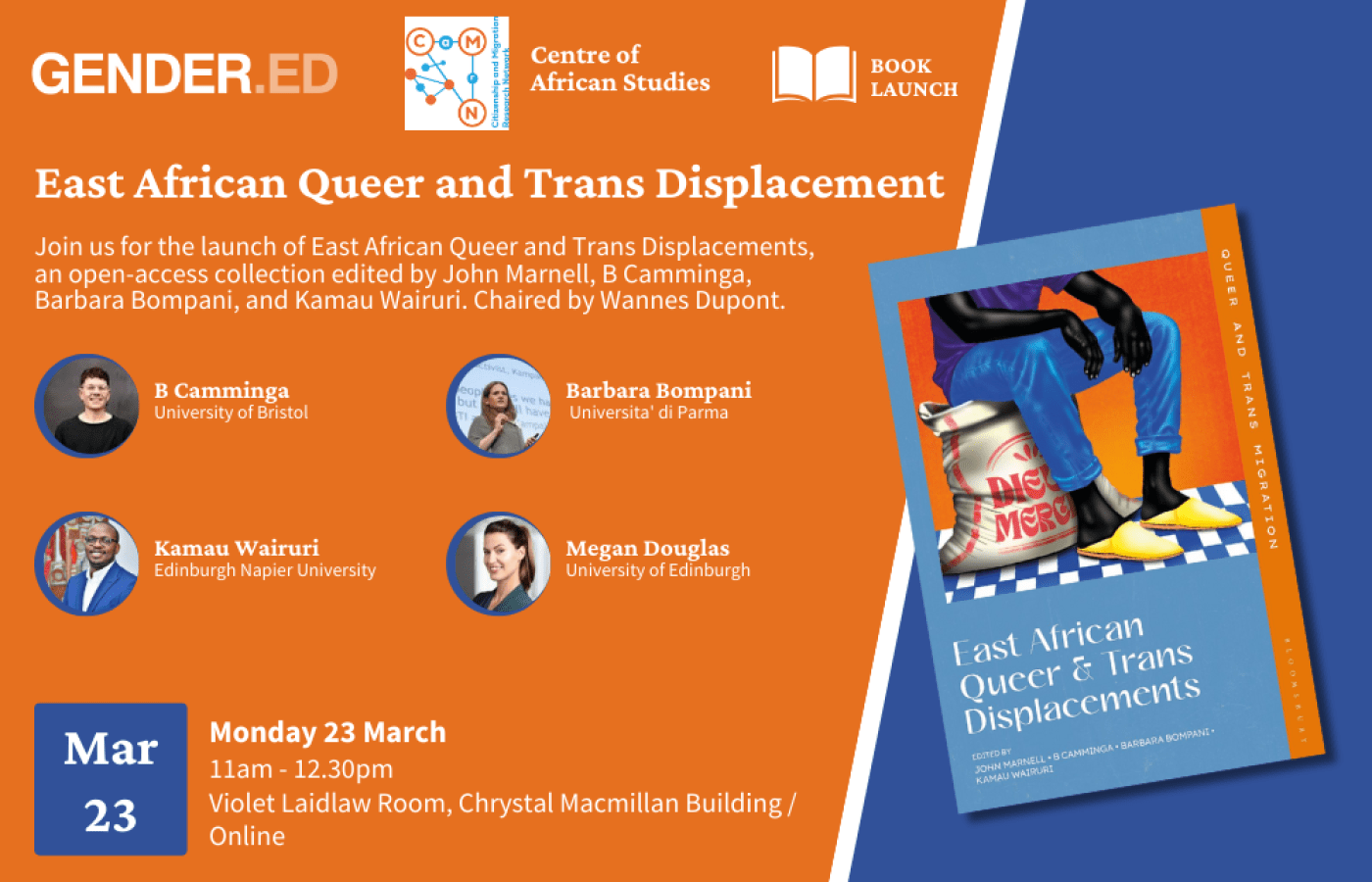
Join us for the launch of East African Queer and Trans Displacements, an open-access collection edited by John Marnell, B Camminga, Barbara Bompani, and Kamau Wairuri.
Within the context of growing state-sponsored homophobia and transphobia in East Africa, this timely collection brings together critical scholarship and lived perspectives to provide the first in-depth examination of queer and trans displacement in the region. Engaging themes of migration, asylum, citizenship, violence, care, belonging, environment, and resistance, the book challenges dominant narratives about sexuality, gender, and mobility in East Africa and beyond.
The launch event will be co-badged by the University of Edinburgh’s Centre of African Studies, GENDER.ED and Citizenship and Migration Research Network, and feature reflections from some of the editors and contributors, followed by discussion and audience Q&A.
Chair:
Wannes Dupont, Associate Director of GENDER.ED, and lecturer in History of Sexuality School of History, Classics and Archaeology. Dr Dupont’s work, publications, and teaching primarily concern the European, and global sexual pasts, queer history, reproductive politics, and the intersections of biopolitics and religion.
Speaker Bios:
B Camminga (Editor) is a Lecturer in the Sociology of Gender at the University of Bristol, UK and a Research Associate at the African Centre for Migration & Society, University of the Witwatersrand, SA. Their work considers the interrelationship between the conceptual journeying of the term ‘transgender’ from the Global North and the physical embodied journeying of African transgender asylum seekers globally. They are the author of Transgender Refugees and the Imagined South Africa (2019).
Barbara Bompani (Editor) (she/her) is an Associate Professor in African History and Institutions at the University of Parma, Italy and honorary fellow at the Center of African Studies at the University of Edinburgh, United Kingdom. Her research broadly focuses on religion, politics and development in Africa. In the past ten years, she investigated the relationships between sexuality and public religion, in particular conservative Christianity, in East Africa. She has published widely on these topics, and was co-editor of the volume Christian Citizens and the Moral Regeneration of the African State (2017).
Kamau Wairuri (Editor) is a Lecturer in Criminology at Edinburgh Napier University, UK. He is interested in the ways that social order is imagined, produced, and maintained in Africa, with a focus on the politics of criminal justice on the continent. His work examines the major themes of criminal and political violence, the state police and their policing of criminalised and otherwise marginalised groups, including sex workers, queer people, migrants and the urban poor, especially young men. His work is primarily situated at the urban margins.
Megan Douglas (contributor) is the Wits Edinburgh Sustainable African Futures (WESAF) Doctoral Coordinator at the University of Edinburgh’s Mastercard Foundation Scholars Programme, and a research associate at the African Center for Migration and Society, University of the Witwatersrand, South Africa. Her research broadly focuses on fashion, urban identities, and forced migration within Africa.
Registration
Click here to register via Eventbrite.
This is a free event, which means we overbook to allow for no-shows and to avoid empty seats. While we generally do not have to turn people away, this does mean we cannot guarantee everyone a place. Admission is on a first-come, first-served basis.
This event is hybrid and the virtual element will take place on Zoom. Virtual attendees will be sent the joining instructions via email prior to the event.
Please note, filming, recording and/or photography may take place at this event.
If you have any queries regarding this event, please email gender.ed@ed.ac.uk.