Feminism, Fascism & the Future: Tracing the Global Anti-Gender Movement with Professor Laurie Essig
Venue
Violet Laidlaw Room, Chrystal Macmillan BuildingMedia
Image
Description
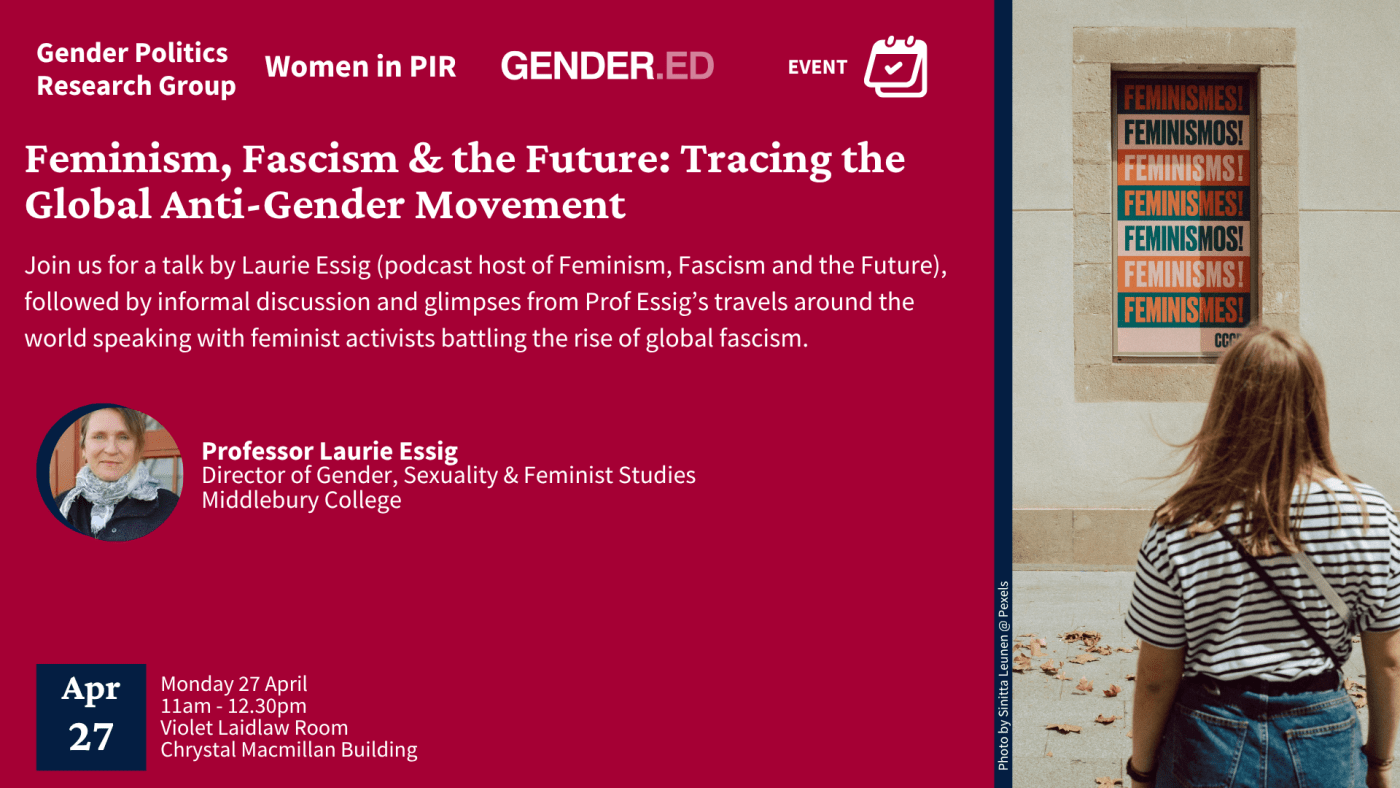
Join us for a talk by Laurie Essig followed by informal discussion and glimpses from Prof Essig’s travels around the world speaking with feminist activists battling the rise of global fascism.
At first glance, the global anti-gender movement can seem like a singular ideological force, but the truth is the anti-gender movement is far from coherent. Depending on context, the anti-gender movement focuses on attacking trans women, abortion rights, gender studies, or even women who don’t reproduce. Yet despite its unpredictable and chaotic nature, the anti-gender movement does have clear and recognizable themes. Around the world, anti-gender movements insist on a stable and binary sex and use the sex binary to create racialized and nationalist hierarchies of value. Anti-gender movements transform the anxieties of economic and climate precarity into an easily defeated enemy whether transwomen in sport or the “overly” fertile migrant family. And finally, anti-gender movements thrive when most of the population is unaware of their existence and thus not prepared to resist them.
What can we learn and, more importantly, what can we do by exploring the global anti-gender movement through a podcast? For the past two and half years, “Feminism, Fascism & the Future has produced more than 25 episodes tracing the contours of the anti-gender movement and making it available to a larger listening public. The podcast has taught us some valuable lessons. First, the anti-gender movement is flexible and able to reshape itself to fit the local context and the current moment. Two, resistance to it is possible, but first we must recognize the anti-gender movement for what it is: a patriarchal restoration project (Butler, 2024) that relies on the retrotopian (Bauman, 2017) logics of fascism. And finally, we need to learn from those who have been resisting racial fascism and/or the logics of settler colonialism for decades. In this talk, I will use episodes of our podcast to lay out some of what we know about the global anti-gender movement and some of what we must still learn as we struggle to keep critical thinking and the complicated truths about sex/gender alive.
Speaker
Laurie Essig is Professor and Director of Gender, Sexuality & Feminist Studies at Middlebury College. She is a sociologist who teaches courses on how power shapes our bodies and our desires Her courses include Sociology of Heterosexuality, White People, and Feminist Podcasting. Her first book, Queer in Russia: A Story of Sex, Self and the Other (Duke, 1999) considered how sexual others are imagined and thus imagine themselves in Russia. Her second book, American Plastic: Credit Cards, Boob Jobs and Our Quest for Perfection (Beacon, 2010) argued that cosmetic surgery in the US is the subprime mortgage crisis of the body, with corporations squeezing profit from working class Americans who hope a more perfect body will lead to a better future. Her most recent book, Love, Inc.: Dating Apps, the Big White Wedding, and Chasing the Happily Neverafter (UC Press, 2019), argued that romance as an ideology became even more powerful in the last few decades even as actual marriage rates declined. Essig has written for a variety of publications including the Boston Globe, the Washington Post, the New York Times, the Conversation and the Chronicle of Higher Education. For the past three years, Essig has worked with feminist collaborators all over the world on to produce the podcast "Feminism, Fascism & the Future.” It explores the global rise in anti-gender ideology movements and what we can do as feminist academics, activists, and artists to fight back. Listen to it on Apple Music, Spotify.
Registration
Click here to register via Eventbrite.
This is a free event, which means we overbook to allow for no-shows and to avoid empty seats. While we generally do not have to turn people away, this does mean we cannot guarantee everyone a place. Admission is on a first-come, first-served basis.
Please note, filming, recording and/or photography may take place at this event.
If you have any queries regarding this event, please email gender.ed@ed.ac.uk.