Tree craft - invisibility and potential
Venue
Chrystal Macmillan Building, Seminar Room 1, The University of EdinburghMedia
Image
Description
Chainsaws have a bad rap. Type “chainsaw” into your phone, and predictive text is likely to suggest “massacre” as the next word. The machine’s widely-loathed “whine” has, in some sense, come to represent humankind’s ill-conceived and ultimately self-destructive attempts to control, colonise, and dominate the natural world. My own induction into this world was a reluctant one, embarking on a course at my local college because I needed to manage some woodland and the idea of wielding a chainsaw terrified me. But, after just a couple of days, I began to appreciate another side to the saw: that, in the hands of a skilled operator, it can become a subtle and delicate tool. Campbell, our instructor, described “feeling” and “knowing” a tree through the way the saw moves, sounds, feels, and even smells, as it encounters points of tension and compression in the wood, uncovering its complex and unique biography. It is through this deep, visceral knowing of the tree – of how it has grown and responded over the years to its surroundings – that it can be effectively worked and cut.
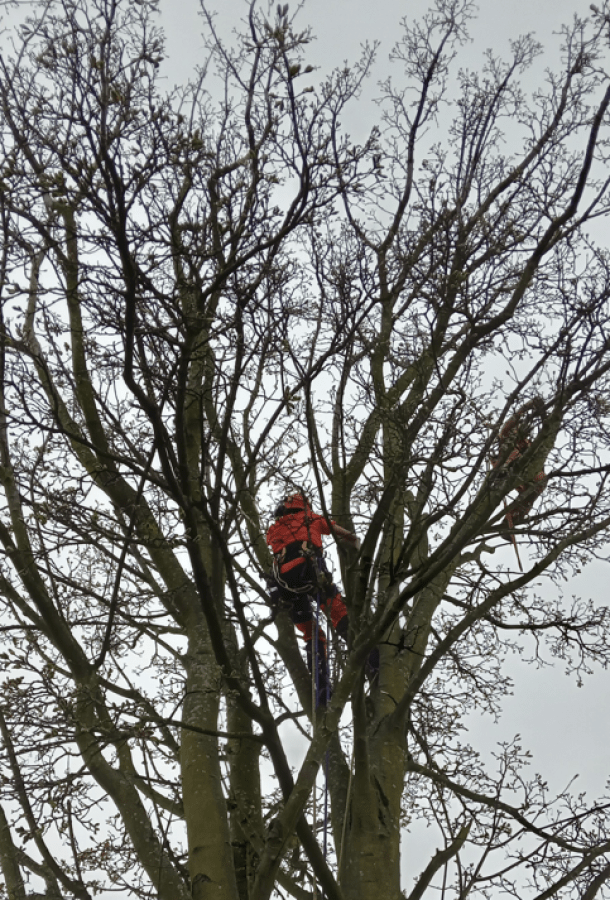
In this paper, I reflect on what I’ve learned about the craft of tree work, through five years (and counting), as an apprentice-ethnographer in arboriculture and forestry. It is a craft that requires immense skill and expertise but, unlike other forms of artisanship (like pottery, weaving or joinery, for example), it typically entails destroying – or at least preserving – rather than creating; as such, there is no finished object to attest to the individual’s skill. Indeed, the aim is often to make the work as invisible as possible: to make it look like nothing ever happened. With pruning or other reduction work, the aim is for finished tree to look as “natural” and as unworked, as possible. And after felling a tree, the stump is cut close to the ground with the felling cuts effaced. The end result is erasure, of both the tree and the cutter’s craft. And yet those absences – gaps where trees or parts of trees were – are also charged with promise and potential, in which new possibilities emerge.
Key speakers
- Kate Hampshire, Durham University