The New Data Economies of Social Enterprise
Principal investigator
Principal investigator
Overview
Description
Project Summary
The New Data Economies of Social Enterprise (2022-2025) was a comparative research project examining how data reshapes governance, accountability, and public value across social enterprise, welfare, regeneration, local development, and circular economy initiatives in Bangladesh and Scotland.
Rather than treating data as a technical tool or neutral resource, the project asks how data systems reorganise relationships: between citizens and the state, organisations and communities, and public goals and economic value. Drawing on ethnographic research and close collaboration with social enterprises, the project traces how data infrastructures shape who becomes visible, how decisions are made, and what kinds of obligations are created or displaced.
A distinctive feature of the project is its emphasis on co-creation and public-facing experimentation. Research findings were translated into interactive digital artefacts developed collaboratively with partner organisations. These artefacts function both as research outputs and as tools for public dialogue, enabling communities, practitioners, and policymakers to explore how data systems work in practice, and where they create friction, exclusion, or new possibilities.
The project was funded by the British Academy and the Wolfson Foundation, ESRC Impact Acceleration Accounts, the Edinburgh Futures Institute, and the Moray Fund. It was hosted by the University of Edinburgh.
Public Engagement and Knowledge Exchange
Public engagement was integral to the research design. The project brought together social enterprises from Bangladesh and Scotland, alongside designers, data scientists, domain experts, and policy-facing practitioners, through an intensive co-creation workshop hosted at the Edinburgh Futures Institute.
This workshop created a shared space for:
- translating ethnographic research into visual and interactive forms
- interrogating assumptions embedded in data systems
- experimenting with how research insights can travel across sectors and audiences
Each digital artefact developed through this process was subsequently launched through public events in the local contexts where partner organisations operate. These events brought together community members, practitioners, and policymakers, generating discussion about data governance, inclusion, and public accountability grounded in concrete cases.
The project has also contributed to policy dialogue, including formal consultation responses and practitioner-oriented reports and briefs, and has catalysed ongoing research partnerships and follow-on funding proposals.
Digital Research Artefacts
The project produced four interactive digital artefacts, each co-designed with a partner social enterprise. Together, they demonstrate how ethnographic research can be translated into tools that support public understanding, institutional reflection, and policy-relevant discussion.
DataSense – Old Age Allowance Narrative Visualisation
https://datasense-oaa.netlify.app/
Focus: Digital welfare, inclusion, and accountability
Location: Bangladesh
This artefact traces the full data journey of Bangladesh’s Old Age Allowance—from registration and verification to payment and grievance redressal—through the eyes of elderly beneficiaries.
Research significance:
By visualising the end-to-end system, the artefact reveals how inclusion depends simultaneously on social recognition and technical legibility, and how mismatches between the two generate exclusion and uncertainty.
Engagement effects:
Launched through a public policy roundtable involving government agencies, NGOs, and inter
Ostrero – CommunityCred.scot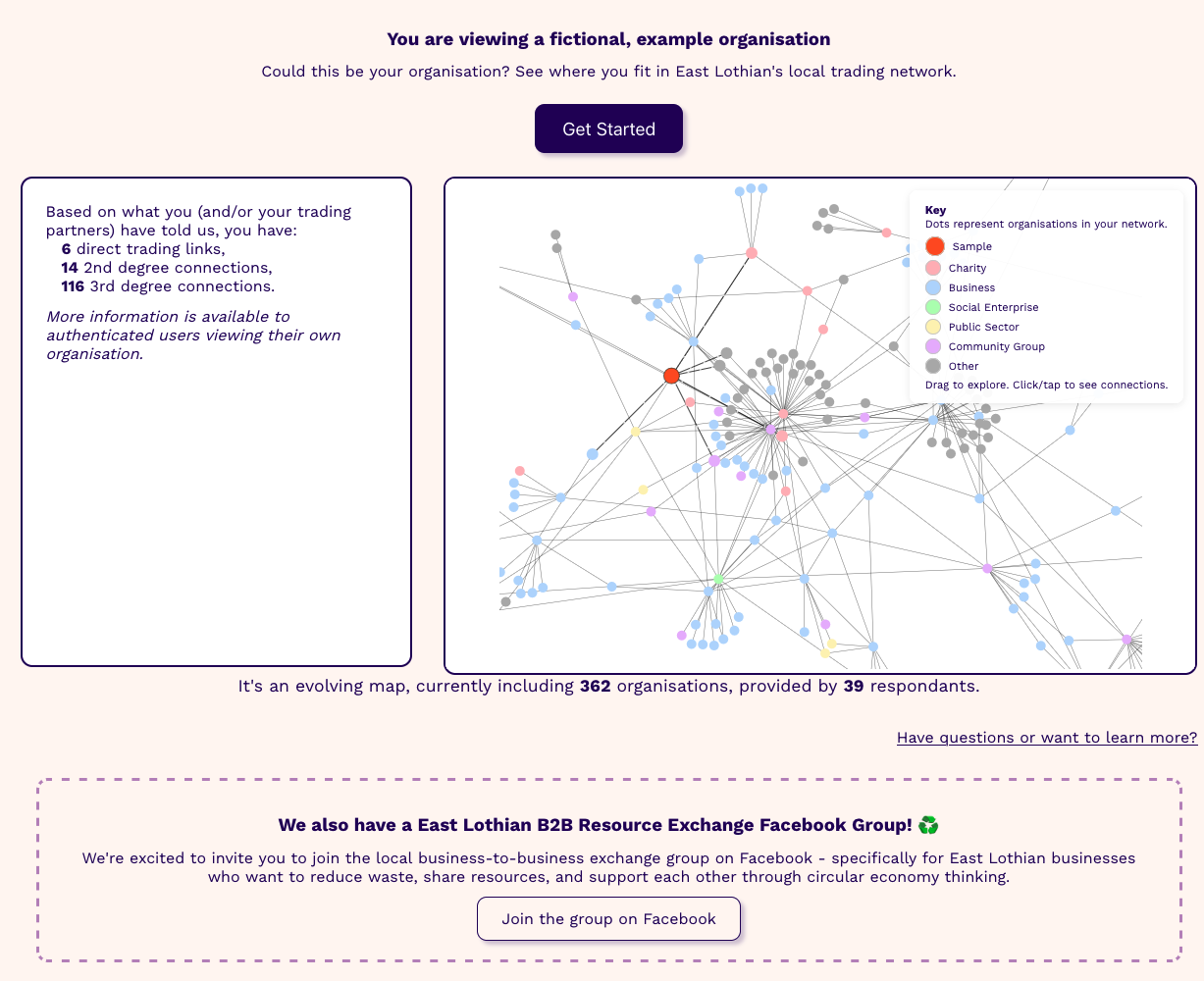
Focus: Circular economy, local exchange, and community wealth
Location: Scotland
In partnership with Ostrero, Happy Porch, and Lower Impact Living, CommunityCred maps trading, reuse, and support relationships between local organisations to explore how value circulates within a place—and how it leaks out. The artefact supports experimentation with circular economy metrics and mutual credit concepts grounded in everyday practice.
Research significance:
The artefact challenges macro-economic and sector-centric approaches to circular economy measurement by foregrounding relational, place-based economic activity.
Engagement effects:
Engaged dozens of SMEs and community organisations and informed dialogue with Scottish Government and third-sector actors, feeding into policy consultation and follow-on research collaborations.
eSheBee – Model Union Project Dashboard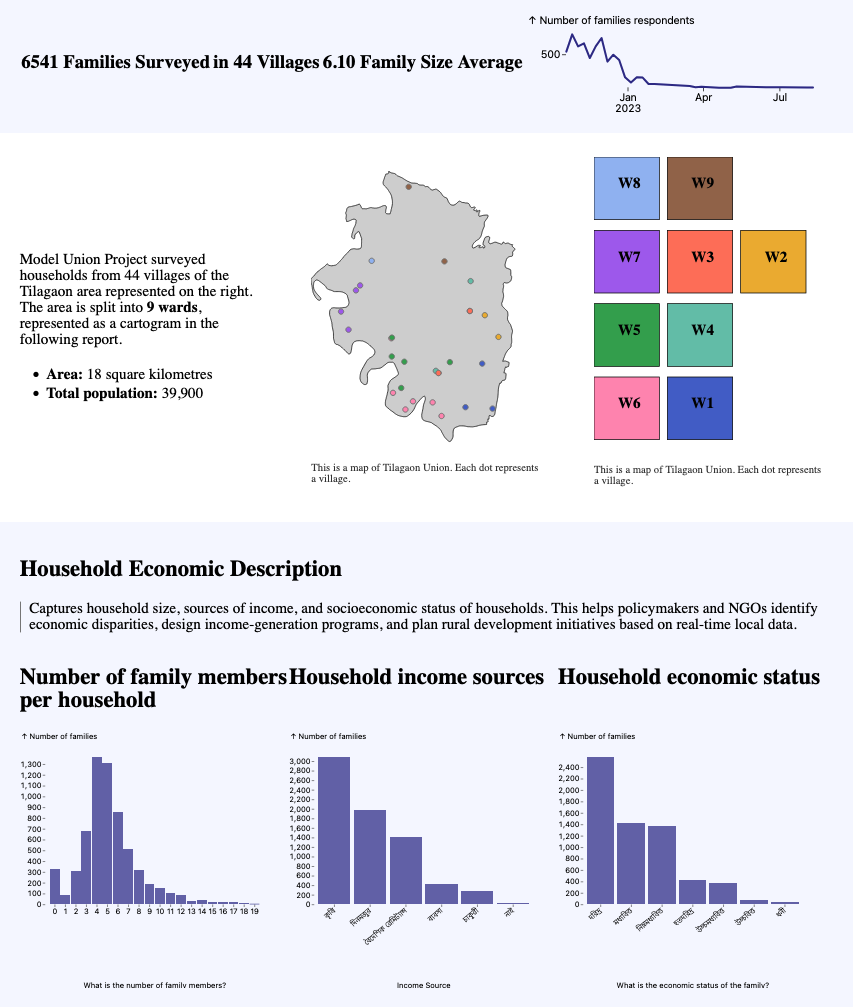
https://edinburgh-futures-institute.github.io/Model-Union-Project/
Focus: Local government, fiscal data, and everyday governance
Location: Bangladesh
This dashboard visualises, for the first time, how household taxation, welfare access, and social demand intersect at the local government level. It brings together administrative data and lived realities to show how citizens and officials navigate fiscal obligations and public services.
Research significance:
The artefact demonstrates how data infrastructures reconfigure accountability without eliminating discretion, revealing tensions between centralised systems and local recognitional labour.
Engagement effects:
Used in workshops and discussions with practitioners and policymakers concerned with transparency, taxation, and local governance reform.
Grand Bequest – RegenerationOS
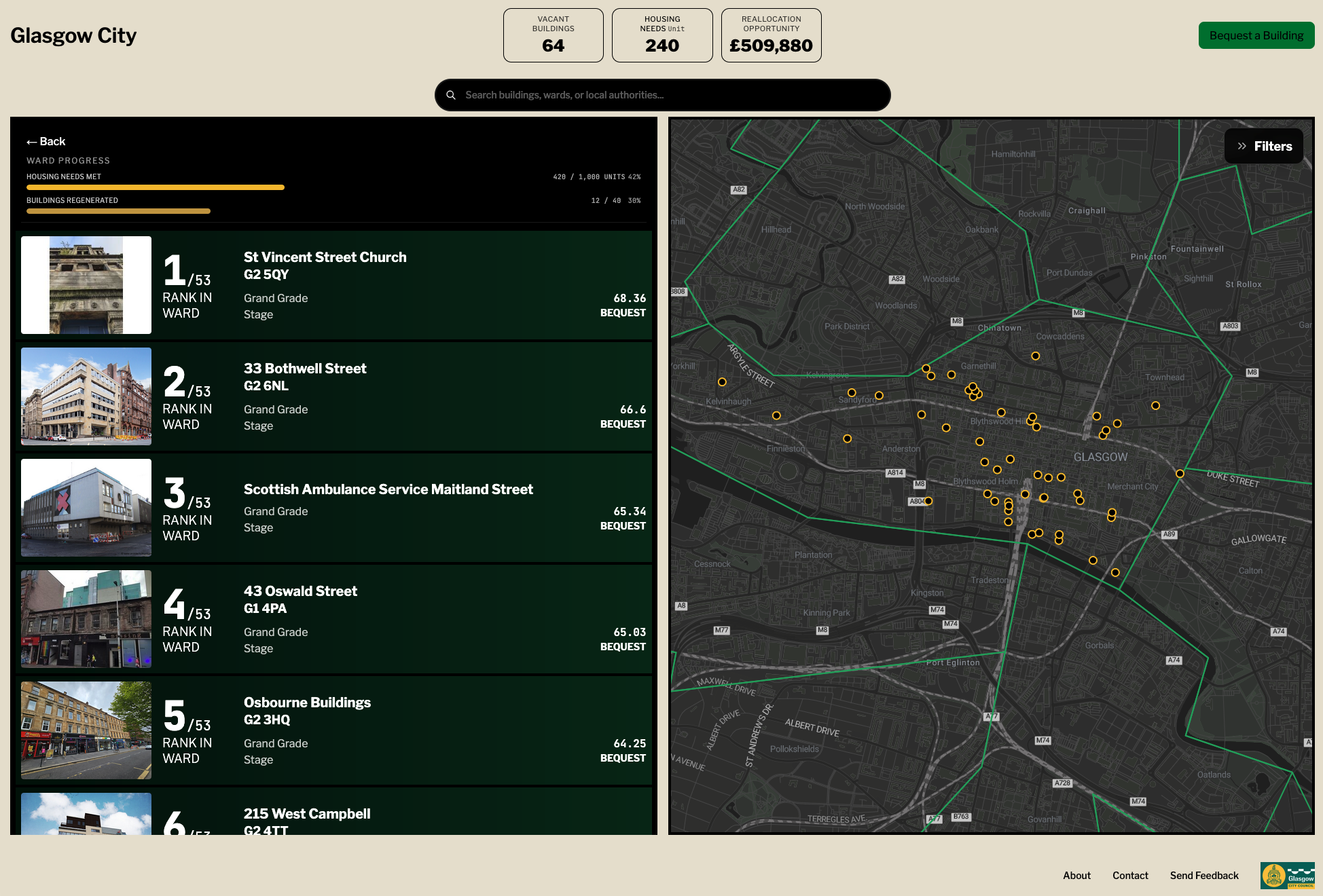
https://grand-bequest-explorer-hn92.onrender.com/
Focus: Empty buildings, regeneration, housing, and public value
Location: Scotland
This artefact explores how data is used to make empty and underused buildings feasible for regeneration. It visualises how information about buildings, ownership, housing need, and local context is assembled to support decisions about reuse, temporary accommodation, and investment readiness.
Research significance:
The artefact makes visible the often-invisible work of feasibility—how data mediates decisions about care, capital, and responsibility in contexts of housing crisis and regeneration.
Engagement effects:
Used in public demonstrations and policy discussions with housing and homelessness officials, prompting debate about data gaps, governance constraints, and alternative regeneration pathways.
This project represents the first phase of a longer-term research agenda on how societies live with data infrastructures—and how those infrastructures might be made more accountable, inclusive, and workable in practice.
Research themes
- Data & Digital
- International development
- Science, technology and innovation
- Studies of information and communication technology
- Technology and material culture
- Work & Economy