Mediating AI innovation for dependable healthcare
Venue
Seminar Room 2Chrystal Macmillan Building
George Square
Description
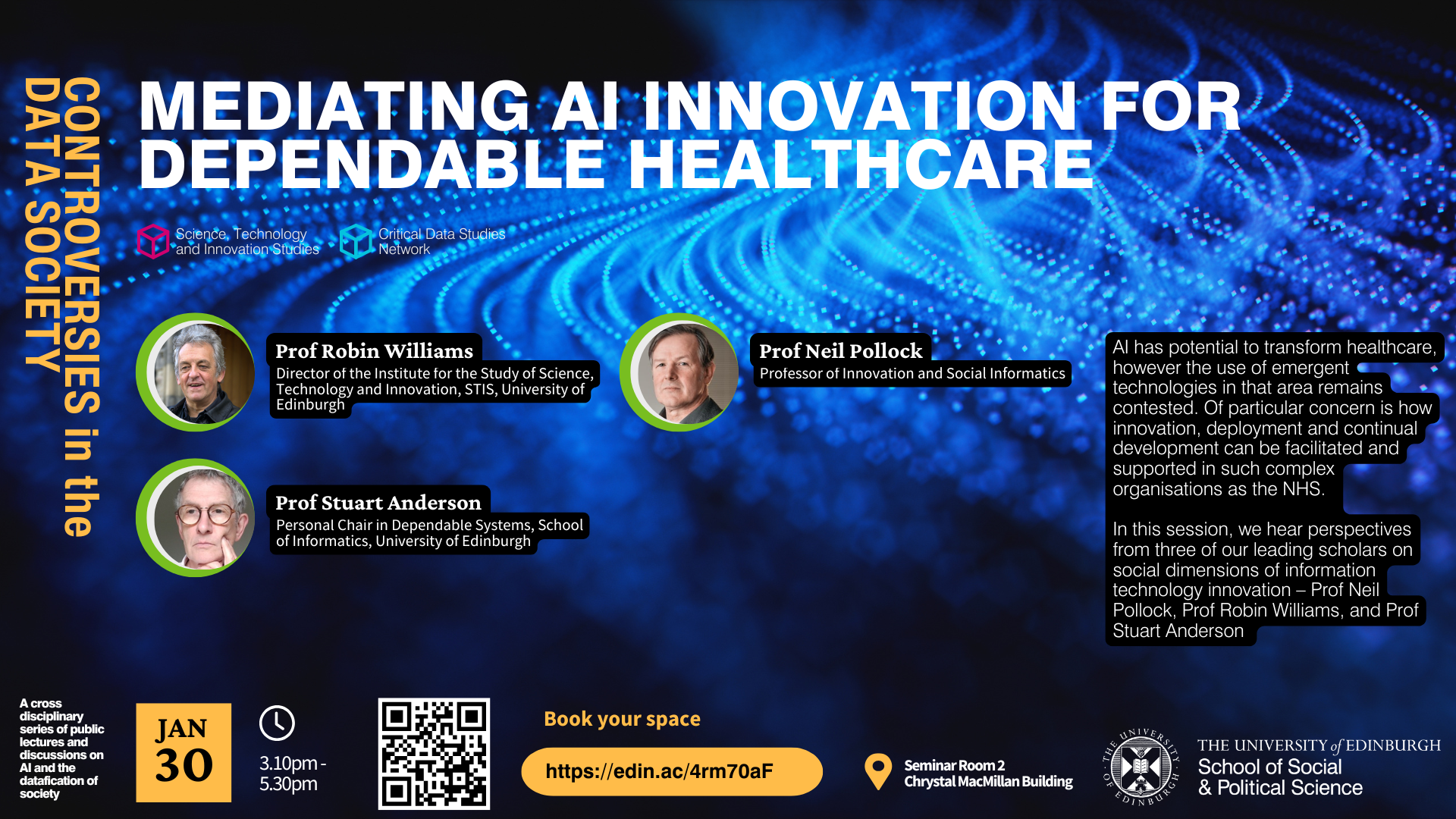
Controversies in the Data Society 2026 series - Session 1
AI has potential to transform healthcare. However, the use of emergent technologies in that area remains contested. Of particular concern is how innovation, deployment and continual development can be facilitated and supported in such complex organisations as the NHS.
In this session, we will hear perspectives from three of our leading scholars on social dimensions of information technology innovation – Professor Neil Pollock, Professor Robin Williams and Professor Stuart Anderson
About this session
Robin Williams and Stuart Anderson will introduce the research they have been doing on information systems in the NHS. Robin will discuss the challenges surrounding safe deployment of medical AI, and Stuart will explore efforts to make medical AI more dependable.
Neil Pollock - in his presentation, Can AI Govern AI? The Visions, Instruments, and Practices of the AI Assurance Industry - will explore the emerging field of 'AI assurance', the attempt to make artificial intelligence systems auditable, accountable, and trustworthy:
Drawing on ethnographic research in healthcare, we trace how AI vendors, clinicians, and specialist assurance firms struggle to define what counts as evidence and who has the authority to judge AI performance. The phenomenon of AI drift, where systems lose accuracy or fairness after deployment, exposes the instability of evidence and challenges traditional retrospective audit models. Using ideas from science and technology studies (STS), especially the notion of the 'trajectory of evidence' (Kruse, 2015), and interdisciplinary accounting (Power, 2022), we show how assurance work involves the continual stabilisation and recontextualisation of evidence to sustain credibility over time. We argue that AI assurance marks a mutation of audit practice, moving from episodic verification to continuous, anticipatory oversight, and raising the possibility that automated systems might one day audit or monitor each other. In addressing whether and how AI might govern AI, the presentation reflects on the limits of human expertise, the redistribution of authority, and the reconfiguration of credibility in the emerging infrastructures of algorithmic accountability.
About the speakers
Robin Williams is Professor of Social Research on Technology in STIS at the University of Edinburgh and Director of the Institute for the Study of Science, Technology and Innovation. His research focuses on the social shaping of technology, highlighting the influence of a variety of actors on the design, implementation and use of ICT. In collaboration with Kathrin Creswell (Usher Institute) he led the Independent Evaluation of NHS England’s flagship Global Digital Exemplar programme. He is Co-I on the UKRI Research Node on Trustworthy Autonomous Systems Governance and Regulation and UKRI Centre for Doctoral Training on Biomedical AI. His current research focuses on the digital transformation of health and social care, and on the safe and sustainable deployment of artificial intelligence in medicine
Stuart Anderson is Professor of Dependable Systems at The School of Informatics at the University of Edinburgh. Stuart is particularly interested in socio-technical systems, resilience of such systems, and how social science and informatics provide a unique perspective on the conception, design, deployment and operation of computer-based systems. Currently, he is working on information infrastructures and their role in analysing long-lived, large-scale systems. Stuart has a particular focus on informatics in health and the NHS. He works on the design and analysis of complex systems and how we ensure they are fit for purpose. This includes both demonstrating fitness and influencing design in practice. This is crucial in the context of safety-critical or dependable systems, where any failure can have unacceptable consequences.
Neil Pollock is Professor of Innovation and Social Informatics at the University of Edinburgh, studying the emerging AI assurance industry. His books include Putting the University Online; Software and Organisations; How Industry Analysts Shape the Digital Future; and the edited collections Thinking Infrastructures, and Market Studies. He has recently completed a further book (with Robin Williams), After Hype: The Business of Taming the Digital Economy, which will be published by Cambridge University Press in June 2026. He is Deputy Editor in Chief of Information and Organisation , serves on the editorial boards of Accounting, Organizations and Society, and Organization Studies, advises the UK Cabinet Office on Digital, Data, Innovation and AI Skills, and is a Fellow of the Academy of Social Sciences. His work has been recognised with the EGOS 2022 James G. March Prize and a 2023 Best Paper award.
Further reading
- Robin Williams, S, Anderson, K. Cressell, M. Kannelønning, H. Mozaffar & X. Yang (2024), Domesticating AI in medical diagnosis, Technology in Society
- S. Gilbert, S. Anderson, M. Daumer, P. Li, T. Melvin, and R. Williams, ‘Learning From Experience and Finding the Right Balance in the Governance of Artificial Intelligence and Digital Health Technologies’, J Med Internet Res, vol. 25, p. e43682, Apr. 2023, doi: 10.2196/43682.
- H. Ozalp, P. Ozcan, D. Dinckol, M. Zachariadis, and A. Gawer, ‘“Digital Colonization” of Highly Regulated Industries: An Analysis of Big Tech Platforms’ Entry into Health Care and Education’, California Management Review, May 2022, doi: 10.1177/00081256221094307.
- Power, M. (2022). Theorizing the economy of traces: From audit society to surveillance capitalism. Organization Theory, 3(3), 26317877211052296.
- Minkkinen, M., Laine, J., & Mäntymäki, M. (2022). Continuous auditing of artificial intelligence: a conceptualization and assessment of tools and frameworks. Digital Society, 1(3), 21.
- Scott, S. V., & Orlikowski, W. J. (2025). Exploring AI-in-the-making: Sociomaterial genealogies of AI performativity. Information and Organization, 35(1), 100558.
Key speakers
- Robin Williams
- Stuart Anderson
- Neil Pollock